Monday, January 11, 2021
It Turns Out...Golf Holes-In-One and Japanese Sumo Wrestling
Friday, December 18, 2020
Mistakes Were Made - 1960 Doyusha Fusa 7: Type 2 (BC603-2)
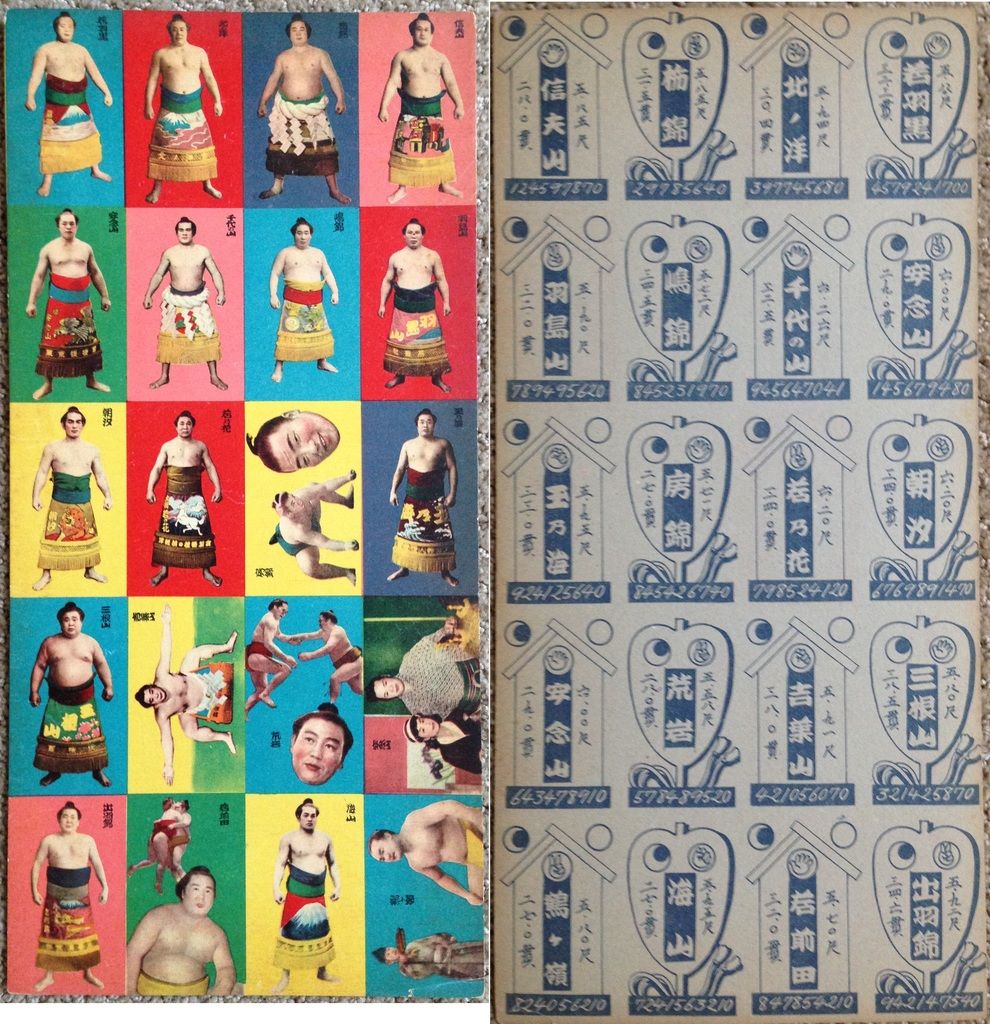
Mistakes on Japanese cards are fairly rare. Mistakes on vintage Japanese cards are even more rare with only a handful of known examples. With the wild west of production from the 1930s to the 1960s, I am surprised there wasn't a ton more. And with hundreds of sets and hundreds of thousands of menko and cards being produced, this is quite the astounding feat. However, one set that got it wrong was the BC603-2: 1960 Doyusha Fusa -Type 2 Set. The front of the menko look normal, but upon turning them over it quickly becomes apparent that someone at the Doyusha factory had a bad day. They got the wrong backs...meaning the name and statistics for another wrestler accidently appear on the menko. Instead of redoing the layout and reprinting, Doyusha overlaid a fan with the wrestler's correct name. The Type 2 set is printed on grey paper stock and is the set that contains the error. The Type 1s all appear correct and were printed on tan paper stock leading me to believe that either A) the Type 1s were printed later after they were all corrected, or B) the Type 2s were printed at another factory and corrected locally. Either way, it makes for an interesting piece of Japanese menko history.
I hope every one has a great weekend and sayonara!
Saturday, August 29, 2020
Post #300! Keeping it Simple!
I'm going to keep today simple. A fellow sumo enthusiast sent me this card of hers that she had with a bunch of other items...she knew it would go to a good home. Boy was she right! Although this BC561: 1956 Marusan Jyunishi Nagai 3-4-6 set is pretty common and menko pop up all the time, surprisingly I did not have this particular menko of then Maegashira Tamanoumi. It is not in perfect shape and well-loved but that is exactly how I like them!
Tamanoumi competed in 4 different decades and was a staple on the banzuke throughout his career. To top it off, he won the November 1957 championship when he was ranked only at Maegashira 14 with a perfect 15-0 record; a record that even some yokozuna aren't able to accomplish.
Stay safe out there and thanks for dropping by for a quick sumo menko tidbit!

Tuesday, May 21, 2019
The Mystery Deepens - Merging 2 1950s Sumo Wreslting Menko Sets
Wednesday, September 20, 2017
1961 Maruta Sumo Menko (BC612) - Tsunkoro Daisuke TV Drama
![]() |
| Image courtesy of http://menkonohako.web.fc2.com/untitled.htm58.htm |

Friday, January 15, 2016
1959/1960 Maruichi Sagari 7 Sets (BC595/BC604)
Anyone watching the Hatsu Tournament? It appears Yokozuna Hakuho is making another run at a championship!
This set(s) is one of the main reasons I love to collect, catalog, and checklist new sumo menko and cards. I thought I had the set(s) figured out and then I dig up new information and found additional menko that proved my original research wrong. I wish I could tell you that I have it all squared away in this blog, but I'll need to spend several hours now revisiting these sets and come up with new checklists which I'll post here and get in my next book edition. I picked up this prize sheet several years ago and tucked it away, but dug it out again recently to double check I had my checklist up to date and to take a picture for reference. Originally I had this set as the 1959 Maruichi Sagari 7 Set (BC595) (Note: I believe Engel incorrectly lists these as a Maruya sets) with two types (with and without borders). As I was reviewing the checklist with this prize sheet I noticed that some of the wrestler's fighting names (shikona) had changed and that the top prizes on this sheet were of only Kashiwado and Taiho who didn't really become popular until 1960 and beyond. Then I noticed subtle differences between the Type 1: White Border menko and Type 2: No Border menko in terms of who is represented in each set indicating different release dates. I remember Engel talking about border and borderless sets being released in different years so I went back and double check and he does mention borderless being issued a year earlier than bordered sets. This very well may be the case here and I am thinking the Type 2 set is actually from 1959 and the Type 1 is from 1960. (A great example of how Japanese sumo and baseball menko research helps and verifies each other) I also translated what was at the top of this prize sheet and it has written "丸一新版相撲面子集" which translates as "Maruichi New Edition Sumo Menko Collection". I take this as meaning an updated and new release of a previous edition.
This prize sheet is what you typically would see hanging up in the dagashiya. It's approximately 24"x 36" and has 1/2/3 prize levels. The 1st-level prize menko are large 8" x 11" and there are 3 of those. The 2nd-level prize menko are six uncut sheets of 4 menko. The 3rd-level prize menko are 16 uncut sheets of 2 menko. In a 100 枚 taba pack that means almost a 1-in-4 chance of winning! As with most prize sheets, the paper is very thin and starting to deteriorate. Hopefully I can figure out how to preserve these someday, but at least the glue used to hold the menko on the sheet is still holding strong.
These menko are very common to find in auctions probably because they were released so late in the menko boom and there was likely a lot of deadstock left over in dagashiya. The set(s) show the rikishi in various poses and action shots agains a mostly solid background or on the dohyo and measure approximately 1.75" x 3.0". Backs are printed in a blue ink and have the "Gu-Choki-Pa" mark in a circle at the top with the shikona down the middle and the 7-digit Fighting Number along the bottom. The left column contains the rikishi's height and weight in kiograms and centimeters and the right column has the rikishi's prefectural birthplace and heya information.