Showing posts with label Takamiyama. Show all posts

Monday, April 25, 2022

1983-1 Japanese Sumo Wrestling Playing Card Set

I just did a video of this 1981-3 Japanese Sumo Wrestling Playing Trump Card Set over on my YouTube channel, but wanted to highlight a few more details here.  The Japanese word for playing cards is Trump or トランプ.  I'm sure there is a background on why it is called "trump"...probably was borrowed from another language.


I really like these trump sets as they feature a lot of wrestlers that really only ever got cards in these sets.  A brief history...these continued to be printed today, but started in 1973.  They usually came out one set per year (except in 2012 when the big match-fixing scandal hit sumo and in 2021 due to the COVID-19 pandemic), but at the height of sumo's popularity in the early 1990s they were cranking out 3 sets per year.  These sets were only available at the kokugikan and souvenir shops.

This particular 1983-1 set was printed in March 1983 and has some notable rikishi in the set: the dai-yokozuna Chiyonofuji as the King Diamonds, the great Yokozuna Kitanoumi as the King of Hearts, Yokozuna Takanosato ranked as an Ozeki as Queen of Spades, the young Asashifuji ranked as a Maegashira before he became Yokozuna later on in the 1980s. and of course Takamiyama who seemed like would keep competing forever.  There was a 1983-2 set made in September of that year that included an extra Queen of Clubs that showed Takanosato as a recently promoted Yokozuna...this was done to hold people over until the following year when a whole new set could be printed.


I haven't been able to research much about who manufactured these sets, but the case does say "Alaska Playing Card Company"...not sure if they made just the plastic storage cases or the whole sets.  A brief search on Google doesn't yield anything.  


Thanks for tuning in and certainly appreciate all the support over the years!


Monday, June 1, 2020

1971 Japanese Sumo Wrestling 3D Lenticular Cards - Move over Kellogg's!

This auction had me super excited as I counted down the days until it ended and I wasn't about ready to let these slip through my fingers.  For the vintage sumo menko and card collectors, this is the toughest set to find in the post-menko era (after 1964).  Some of the very first lenticular/3D cards in both the Japanese baseball and sumo world, this 15-20 card set features baseball players, boxers, and sumo wrestlers.  These black-backed wonders capture the very first card of Takamiyama, the first foreigner to win a sumo tournament, as well as Tamanoumi who was destined for greatness only to pass away shortly after this card was produced from appendicitis.  I have seen only one other of these (another Takamiyama) and these will likely only pop up once every 5-10 years at the rate I am seeing them.  Distribution of these is unknown, but could have very well been issued with candy or gum.  Have a great week and stay safe out there.  Sayonara!


Saturday, February 24, 2018

1980 Sumo Wrestling Trump / Playing Cards

In 1980, if you were living in Japan, sumo wrestler Chiyonofuji would have been a household name.  His face was plastered on everything it seemed.  Although he hadn't been promoted to the highest rank of Yokozuna yet, it was clear he was headed there.  Finding trading cards of him from this era is somewhat of a challenge and collectors are really limited to mainly these playing cards, or trump cards as they are called in Japan.  These were annual sets released at the Kokugikan and captured 52 of the top ranked wrestlers within a playing card set.  This 1980 set is especially interesting as it has 6 current or future Yokozuna in it as well as 2 of the most popular wresters from the 1970s and 1980s. Lets dive into a few of the wrestlers featured in this set.


Kitanoumi was a beast.  He was the youngest ever Yokozuna at 21 years of age when he was promoted in 1974 and eventually served as the chairman of the Japan Sumo Association.  In 1980 he was on the downhill slop of his career but still managed to eventually reach 24 tournament wins!


Wakanohana was a pretty dismal Yokozuna and won only 4 championships in his career.  Why the sumo association decided to promote to Yokozuna after posting two runner up championships is baffling.  Normally promotion to Yokozuna occurs after two back-to-back championships.  He had a storied life after his active wrestling days were over and eventually he married a girl he met while she was working in a bar.


Maybe even more disappointing than Wakanohana was Mienoumi as a Yokozuna.  He managed only 3 tournament wins and retired a little more than a year after his promotion.   Why he was promoted after two runner up championsips is equally as baffling as Wakanohana.   Although, from a card collectors standpoint, capturing his as a Yokozuna on a card is pretty rare and so its exciting to see him here as the King of Diamonds.  Mienoumi eventually became head of the Japan Sumo Association and became director of the Sumo Museum after he stepped down from that position.


Wajima had a great career as a wrestler, but fell into debt after retirement.  He eventually became a pro wrestler with Giant Baba's promotion to try and pay off those debts.  Wajima is still alive and kicking although not in great health.


Takamiyama (Jesse Kuhhaulua) is forever etched in the pages of sumo history.  As the first foreign winner of a tournament, he gained international fame.....as popular, if not more popular than most of the Yokozuna he fought.  In 1980, he had settled in to being a rank and filer but still would wrestle for another 5 years before retiring and becoming a coach.  If you don't know his story, I'd recommend clicking on the link above and reading about it.  It is very inspirational.


Takanohana was sumo's pretty boy for most of the 1970s and early 1980s.  He was handsome and had a fairly athletic build compared to most wrestlers, however, he couldn't obtain the elusive rank of Yokozuna and stalled out at Ozeki.  He married a beauty queen and they had two handsome sons who eventually went on to become Yokozuna themselves...the first time in history two brothers were Yokozuna.  In 1980s he was nearing the end of his storied career.


Takanosato was relatively old when he was promoted to Yokozuna.  Seen here as a Maegashira-ranked wrestler in 1980, he wouldn't obtain the coveted rank until 3 years later.  Because of his age, he was rather disappointing as a Yokozuna with only 4 championships to his name.


We started off talking about Chiyonofuji and we'll end with him.  Here he is as a Maegashira, but a year later he'd be Yokozuna.  He was extremely skillful, handcome, chiseled and had an amazing physique.  He eventually went on to win 31 championships.  Rumor has it that Chiyonofuji's victory over Takanohana (shown above) caused him to retire.  Years later, Takanohana's son, Takahanada, was the reason Chiyonofuji retired after Takahanada beat him.  What goes around comes around I guess.


Here is a picture of the back of the playing cards.


Thanks for stopping by!

Thursday, October 19, 2017

1984 - The Year the Hawaiian Sumo Torch was Passed

1984 marked a pivotal year in foreign participation in sumo wrestling....especially for the Hawaiian wrestlers.  Superstar Takamiyama (Jesse Kuhaulua from Hawaii) ended his historic 20-year career in sumo wrestling.  He racked up an impressive career.  Jesse was the first foreigner to win a sumo tournament and at the time of his retirement had the most kinboshi(victories over yokozuna), most career bouts with 1,653, and was the third heaviest wrestler in sumo history.  Jesse was well like and it was a difficult adjustment for those used to seeing him in the ring after 20 years.  In 1984, up-and-coming Hawaiian superstar Konishiki (Saleva'a Atisano'e from Hawaii) had just broken into the top ranks of sumo and would go on to have a storied, although troublesome, career retiring in 1997.  By all standard marks, Konishiki would have been promoted to yokozuna with his impressive succession of tournament records, but his status as a foreigner and the Sumo Association's general dislike of him prevented him from reaching this goal.

The 1980s were dismal in terms of sumo card sets.  The only sets being produced were playing card sets with pictures of the wrestlers on them.  This 1984 set is the only set that captures the handing of the Hawaiian sumo torch from Takamiyama to Konishiki.  Takamiyama was designated the Jack of Spades and Konishiki the 7 of Diamonds.  Face cards were reserved for the top-ranked wrestlers and Takamiyama was well deserving of this honor.

Saturday, May 20, 2017

c1977 Sumo Tonton Game Cards (New Set G771)

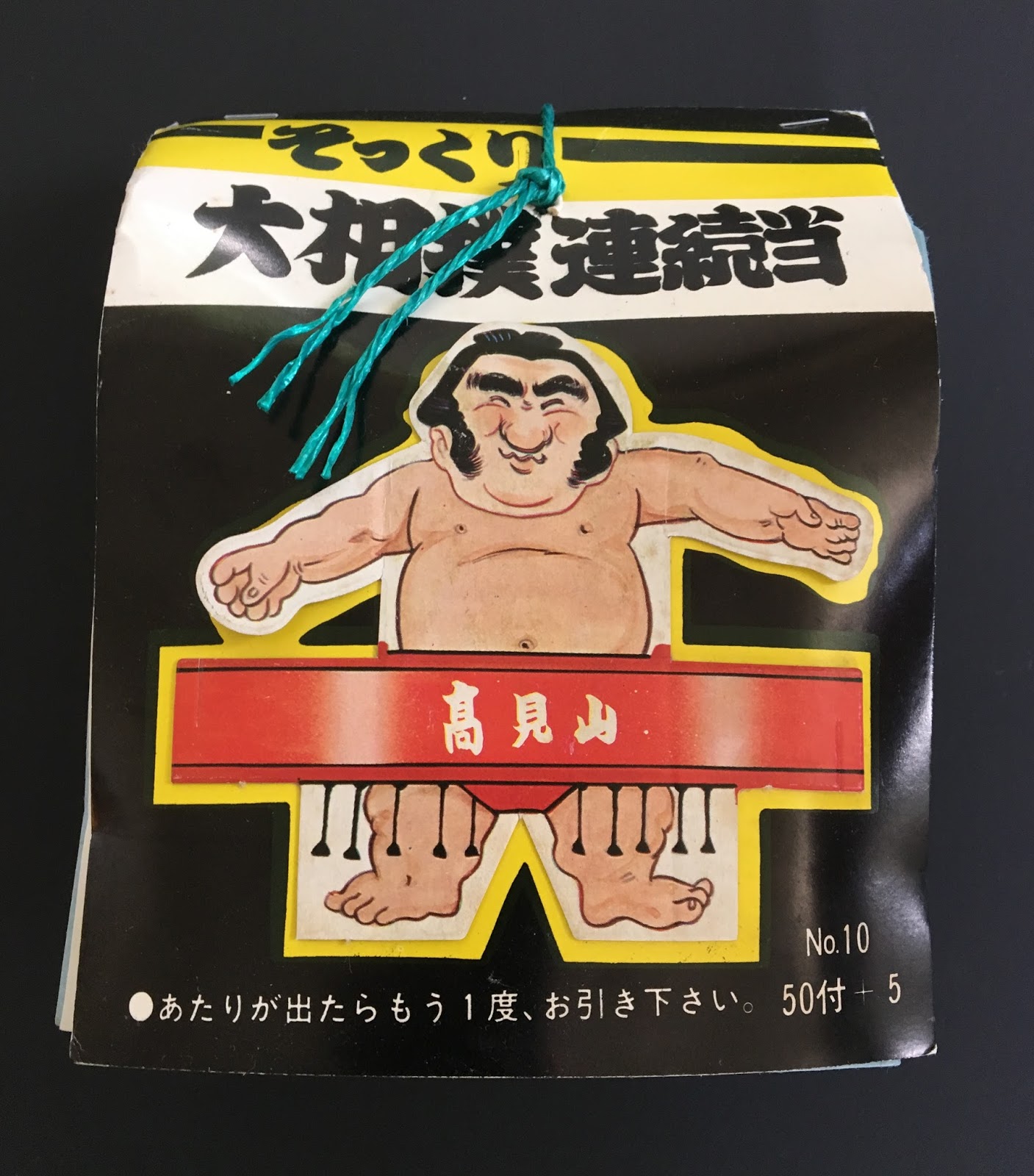
I've been eyeing this set for a while and pulled the trigger the other day as I have never held a card in hand before.  It is a late 1970s Tonton unopened taba bundle with 55 packs (50 regular + 5 bonus packs).  I am assuming there are 5 winner packs randomly in the bundle so you would get a bonus pull if you pulled one of these winner packs...thus the 55 total packs.  These cards are awesome in hand and the bundle is quite thick.  The manufacturer is unknown, but likely one of the big companies from the late 1970s like Yamakatsu, Marusho, or Bull Mark.  Each pack contains two game cards which are intended to be folded and used to play Tonton sumo.  The likeness of each wrestler is used and their shikona is written on their mawashi along the middle. Tonton sumo is a tapping game where you place the pieces in front of each other and tap the table or playing board and the wrestlers move and push each other.  The first piece to fall over is the loser.  Each card is about 3 3/4" x 3 3/4" unfolded.  I was particularly attracted to this bundle because it has the famous Takamiyama card attached to the front which was used to show kids and example of the card they could pull from the packs.  I opened up one of the packs and folded the piece to show you what they look like.  The arms can be folded into different positions as well to try and gain an advantage over your opponent.  Good stuff!


Thursday, April 28, 2016

1973 Calbee Sumo Set

I'm usually a player at most sumo menko and card auctions when there are items that I don't have or I see something unique.  However, one set that I am far from completing and will likely not complete anytime soon is the 36-card 1973 Calbee Sumo Set.  Baseball Card collectors are probably envious as this is the one and only Calbee set ever printed of sumo wrestlers.  And for some reason that I'm still trying to figure out, this is THE MOST expensive sumo menko or card set in existence.  The average price for one of the more common cards is over $100 and the Yokozuna cards can bring easily $300-$400.  I can pick up 1800s menko for fractions of the cost that these cards command.  Additionally, there are menko sets from the 1930s and 40s that are much rarer than the Calbee set, but they don't come close to what collectors are paying for this 1973 set.  And these cards are always up for auction, although some more often than others.  I think it has to do with supply and demand as there are a lot of collectors that remember these from their childhood and are building the set now that they have more expendable income.  This set, like most of the cards at the time, are aimed at the older crowd and weren't marketed as menko or mini cards, which were really aimed at the kids of the day.  I've read on some Japanese blogs that the Calbee sumo card sales were a huge failure and that is why you didn't see any further sets produced.  I'm not sure why they wouldn't have been popular, but baseball cards were also sold the same way and must have been much more popular and profitable.  

These cards were issued in bags of potato chips and came one per bag and measure 2.25" x 3.25".  The rank at the time of printing represented the Nagoya 1973 basho.  Perhaps the most significant cards of the set are the #11, #32 and #33 cards of then- Maegashira Takamiyama (American Jesse Kuhaulua) who was the first foreigner to win a tournament.  Although Takamiyama has other 1970s cards, these are by far some of his earliest.
'
Front and Back of #11 Maegashira Takamiyama

There is also an album that accompanies the set and is meant to hold all 36 cards.  It is unknown how to acquire this set, but likely from sending in payment as a special offer.


Front, Middle and Back of the Album

 Here is 36-card checklist:

36 – Ozeki Takanohana vs Ozeki Kiyokuni
35 – Yokozuna Kitanofuji
34 – Yokozuna Kitanofuji
33 – Maegashira Takamiyama
32 – Maegashira Takamiyama
31 – Sekiwake Kaiketsu
30 – Ozeki Daiju
29 – Ozeki Daikirin
28 – Ozeki Takanohana
27 – Ozeki Takanohana
26 – Ozeki Kiyokuni
25 – Yokozuna Kotozakura
24 – Yokozuna Kotozakura
23 – Yokozuna Kitanofuji
22 – Yokozuna Kitanofuji
21 – Yokozuna Wajima
20 – Yokozuna Wajima
19 – Yokozuna Wajima
18 – Yokozuna Kitanofuji
17 – Yokozuna Kitanofuji
16 – Yokozuna Wajima
15 – Yokozuna Kotozakura
14 – Maegashira Washiyuyama
13 – Maegashira Owashi
12 – Maegashira Hasegawa
11 – Maegashira Takamiyama
10 – Komusubi Kitanoumi
9 – Komusubi Yutakayama
8 – Sekiwake Asahikuni
7 – Sekiwake Kaiketsu
6 – Ozeki Takanohana
5 – Ozeki Daiju
4 – Ozeki Kiyokuni
3 – Ozeki Daikirin
2 – Yokozuna Wajima
1 – Yokozuna Kotozakura

Someday when I have "conquered" the older stuff, I plan on completing this set along with other modern BBM sets.  Hopefully the supply will still be there when I decide to jump in and invest my time and money.