Wednesday, August 10, 2016

A short guide to 1970s-1980s Japanese Mini Cards via the 1983 Amada LSI Game Mini Card Set

     Japanese card collectors in the 1970s and 1980s were bombarded with a ton of collecting options ranging from menko, bromides, and mini cards which covered a wide variety of topics like tv shows, anime, movies, singers and video games.  Apart from my sumo wrestling card hobby, I love to collect cards from the 1970s and 1980s, especially if they have a theme that I am particularly interested in or can relate to.  Japanese mini cards are my main focus from this era and I wanted to give a short guide to collecting these cards in the 1970s and 1980s via the 1983 Amada LSI Game Set.

    Mini card production started around 1973 and ended approximately 12 years later in 1985.  As irony would have it, the subject of today's review (1983 Amada LSI Game Set) was likely the reason for the demise of the mini card as Japanese kids turned their attention from card collecting to video games and electronic entertainment.  But if you were a kid in 1983 and wanted to buy mini cards, you likely would go to a Dagashiya (Candy Shop), like the picture below, to browse the selections and make your purchases.  Dagashiya have been around in Japan for decades and where you would purchase menko in the 1930s-1960s , but today when you find one they are more for tourists and nostalgia.


   Once inside the shop you would be bombarded with candy, hanging bromide taba, small toys and of course mini card boxes like the one below.  Most dagashiya owners went to wholesale districts regularly to stock up on goods for the store and you see this still in Japan with the fish and meat markets scattered about in the bigger cities.  In order to prepare the box for display in the store the owner would remove the prizes as well as the envelope of sealed winner card packs.  See pictures below.  The prizes would be kept behind the counter and the winner card envelope opened and the winner packs would be randomly distributed among the regular, non-winning packs.  I'm not sure why the winner card packs were originally segregated, but likely so the owner could distribute as he/she saw fit, or because the cards were stamped separately and it was easier to package them separately. 


   The cover of the box, like most mini card boxes, shows what kind of cards you would be buying as well as what the odds were of getting a winner card.  The 1983 Amada LSI Game set came with 60 packs (2-cards per pack)...50 packs of regular or "Loser はずれ cards" and 10 packs of winner cards.  The prizes in this box are 2 Grand, 2 1st Level, 3 2nd Level and 3 3rd Level prizes.  As mentioned above, the winner card packs were distributed throughout the box by the owner.  It's impossible to tell from the pictures above put the Grand Prize (Gray) was a pack of 12 cards, the 1st Level Prize (Blue) was a pack of 8 cards, the 2nd Level Prize (Black) was a pack for 5 cards, and the 3rd Level Prize (Red) was a pack of 3 cards.  Most often these prize packs contained more of the same of the regular cards.  If you haven't caught on yet, the big push with mini cards was really all about gambling; the chance and motivation to get bigger cards and prizes.  Each pack, or chance, cost 10 yen and considering in 1983 the exchange rate was about 250 yen per US dollar, each kid was buying a pack for about 4 cents....which seems comparable to what kids were paying in 1983 per card....maybe a little more.  So after paying 10 yen, the kid would pick, or the owner would choose a pack, and the kid would start ripping.  If a winner card was opened, the owner would cancel the card (usually with a pen or marker through the winner stamp) and give the card back to the kid along with his/her prize.
 
  The below picture contains some single cards I have picked up over the year to give you a better idea of this set which was to highlight and showcase different handheld LCD video games from the early 1980s.....this set really seems like a big marketing ploy by the top game manufactures to get you to buy their electronics (Bandai, Tomi, Epic, Takara).  I've never played any of the games in the set, but they sure do look interesting and many of the games are still available on eBay for a hefty sum.  The Japanese called the early electronics LSI, an acronym for Large Scale Integration, which was the process of integrating thousands of transistors on a single silicon microchip (Thanks Wikipedia for the quick reference).  Also note below is a uncancelled winner card for a 3rd Level Prize.  More often than not, you see cancelled winner stamps on cards that come to auction, but occasionally you see uncancelled cards, and my guess is that these uncancelled cards were acquired on the secondary market many years after the set was originally sold and so there was no chance to claim a prize.  I consider these cards "parallel cards" and collect them right along side the regular/loser cards. 


   I don't have the set checklisted yet, but it is on my to-do list when I come across a hoard of these next time. 

Sunday, August 7, 2016

R377 - 1937 Rikishi Gunbai 4

  There is nothing nicer, and more popular, in my opinion than a 1930s R-series sumo menko set.  R-series menko were nothing new in the 1930s and, in fact, had been around since the turn of the century, but a huge resurgence of sumo popularity was spurred by the great Yokozuna Futabayama.

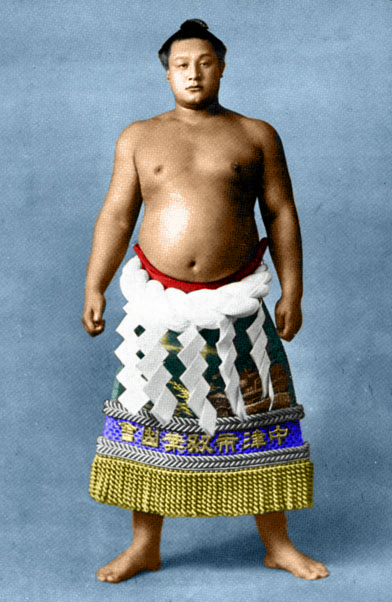
The 35th Yokozuna Futabayama (photo courtesy of Wikipedia)

  Futabayama hit his stride in the mid-1930s and eventually made it to yokozuna which kicked off a flurry of sumo menko sets production.....and timing is everything as there was also a surge in overall menko popularity in the 1930s.  These two factors have made for a treasure trove of sets to chase and pursue from this era.  1930s R-series menko are not that rare (obviously some more than others) and surprisingly a vast majority of them survived the war through fires, bombings, and paper drives.  It is unimaginable how many must have been produced to still see them come up for auction today.  One such set is the R377 - 1937 Rikishi Gunbai 4 set that was produced by an unknown company likely trying to capitalize on Futabayama's dohyo prowess.  As is somewhat common for this era, registration can be spotty at best for these sets and the quality of paper used was often poorly produced.


  This particular set is unique in the fact that there were two colors of ink used to print the back: blue and purple.  My only two guesses for this is the manufacturer likely used whatever color was available (maybe scarcity of certain colors) or they were produced regionally and standardization wasn't addressed.  As with all R-series sets, this one is die-cut and uses nice and vivid colors on the fronts to depict the kesho mawashi aprons used as part of the ring entrance ceremony.  Registration, especially noticeable with red, is quite poor with the R377-2 Type 2 Purple Backs, but seems to have been cleaned up when the R377-1 Type 1 Blue Backs were printed.  There are too few of these out there to make any definitive conclusions though.  Unfortunately, I haven't located a Futabayama from this set yet, but I'm sure there is one out there.  I do like the clean and simple design on the back dominated by a large referee fan with the wrestler's name in the middle and rank at the very top.  The bottom shows the wrestler's weight with a 4-digit fighting number at the very bottom.  Overall, most menko are about 1.5" x 2.25".

Here is the checklist so far from this set:
8958 – Maegashira Takanobori
8901 – Maegashira Nayoroiwa
8702 – Maegashira Itstsushima
7256 – Sekiwake Asahigawa
6728 – Komusubi Yamatoiwa
4860 – Yokozuna Minanogawa
2812 – Sekiwake Taikyuzan

Wednesday, August 3, 2016

Lone Sole Mate / New M-Series Set: M526 - 1952 Trump 5

I have a binder of "To-be-checklisted" sumo menko sets.  These are sets I have just acquired and that I have not yet entered nor checklisted in my book.  Normally the amount of sets in my binder number between 5-10... I'm always cataloging and clearing new sets as new ones come in.  I define a set as having two or more menko, however, I also have a section in my binder called the Lone Soles.  These are menko I only have one of and can't catalogue them since I usually need at least two menko to narrow down a year.  Some of these Lone Soles have been in there for years....in some instances almost 10.  This week I was able to move one of my menko out of the Lone Sole section and into the queue for cataloguing due to finding another one from the set.  Nothing brings me more joy, other than discovering new sets, than finding a match (or Sole Mate if you will) to my Lone Sole pile.  Sumo menko collecting will never be as mainstream as baseball or football, but in this small niche collecting community, these are the discoveries that get us excited.

This Lone Sole Mate is a a new M-Series set from 1952 and I've catalogued it as the M526 - 1952 Trump 5.  I had the #53819 Yokozuna Chiyonoyama menko for what seemed like an eternity, but I picked up the #62357 Yokozuna Terukuni menko recently at auction.  I've deduced it's from 1952 as Terukuni retired early on in 1953 and Chiyonoyama didn't promote to Yokozuna until later in 1951.  This set has the possibility of being from 1951 or 1950, but I'll update it if I happen to find any more of these rare bad boys.  I love the artwork on this set and the colors are nice and vivid.....also having a red-inked back is quite rare too as most sets usually have blue, brown, black, purple, or green.  Red is really uncommon.

I am hoping that more of these exist out there, but given that I have only found 2 in my 16 years or so of collecting, I am unlikely to find many more.  If a Wakanohana menko of this set exists, that would be the big menko of this set as it would be considered his Debut Menko.....much like a rookie card is defined.